
Additives for industrial adhesives
In adhesive and sealant manufacturing, finished-product quality depends not only on the base resin, but also heavily on how well common issues are controlled throughout production and application—such as foam/entrapped air, surface wetting ability, dispersion stability, and consistency (viscosity). If foam/air is not properly managed, the adhesive film can easily develop craters and pinholes, leading to defects during coating or lamination. When the adhesive has difficulty wetting “low-adhesion” substrates such as PP/PE, films, or silicone-treated papers, surface defects and poor adhesion may occur. In addition, pigments and fillers may agglomerate or settle, causing uneven color, speckled surfaces, and abnormal viscosity increase. Finally, if viscosity changes over time, pumping, dosing, and quality control become difficult to stabilize—resulting in defects and higher overall costs.
Core solutions for adhesives
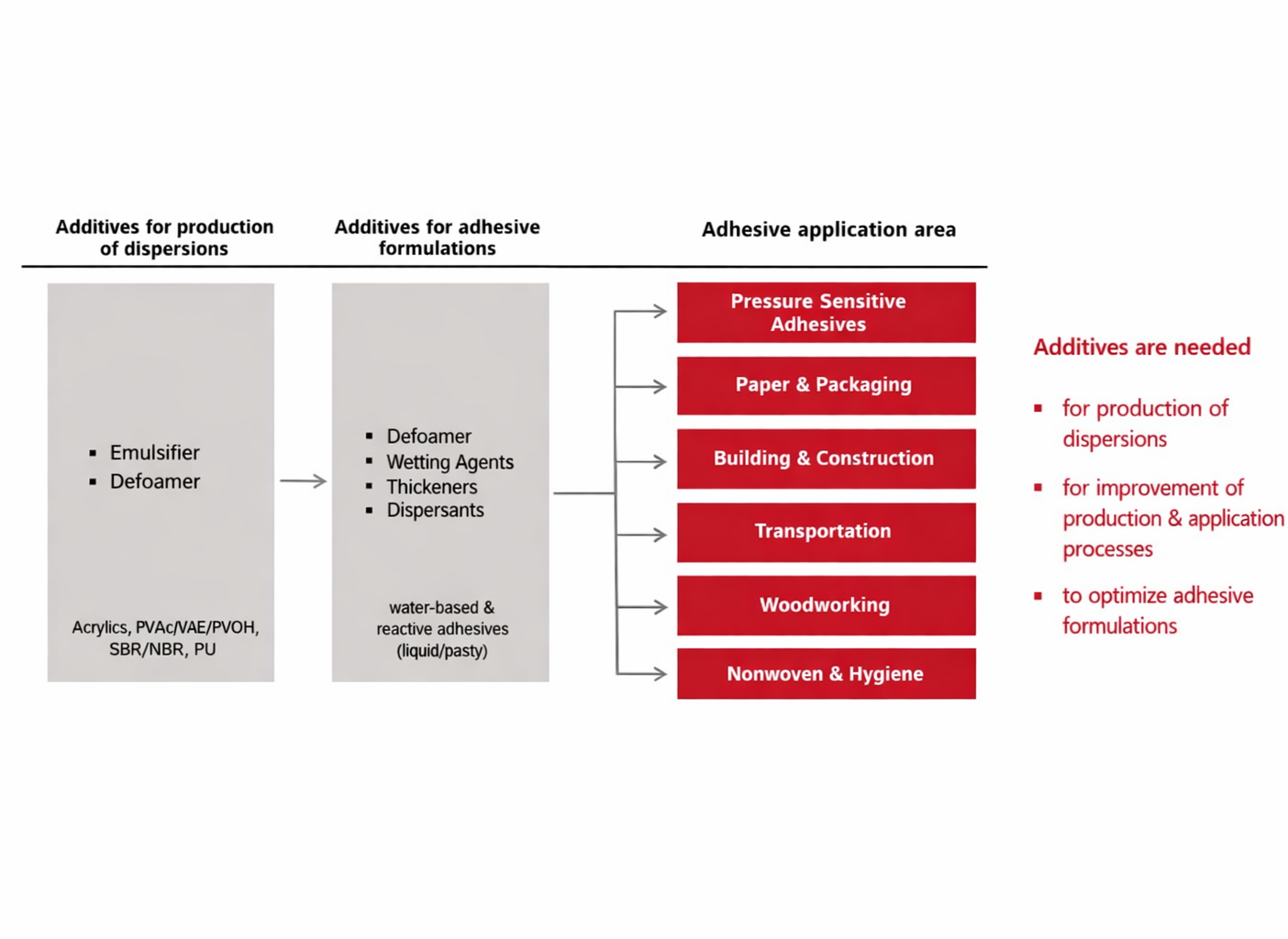
Additives help keep adhesive production stable, reduce defects, and improve finished-product quality. Depending on the application—such as pressure-sensitive adhesives (PSA), paper & packaging, construction, wood, nonwovens & hygiene products—additives are used to defoam/deaerate, enhance wetting and flow/leveling, stabilize pigments/fillers, and fine-tune rheology (viscosity) to optimize both manufacturing and application.
- Defoaming/Deaeration – TEGO® Antifoam: fast and long-lasting defoaming; reduces craters and surface defects; helps the production line run more smoothly.
- Wetting agents – SURFYNOL® / TEGOPREN®: improves wetting and spreading; enhances adhesion on difficult substrates; suitable for high-speed processes.
- Dispersants – TEGOMER®: breaks down agglomerates and stabilizes pigments/fillers; delivers uniform color with reduced settling; optimizes viscosity for easier processing.
- Rheology modifiers – TEGO® Rheo: “tunes” viscosity to the target profile; improves sag resistance while maintaining easy pumping/dosing; enhances long-term formulation stability.
TUBALL™ MATRIX – Graphene nanotube solutions for the Adhesives industry
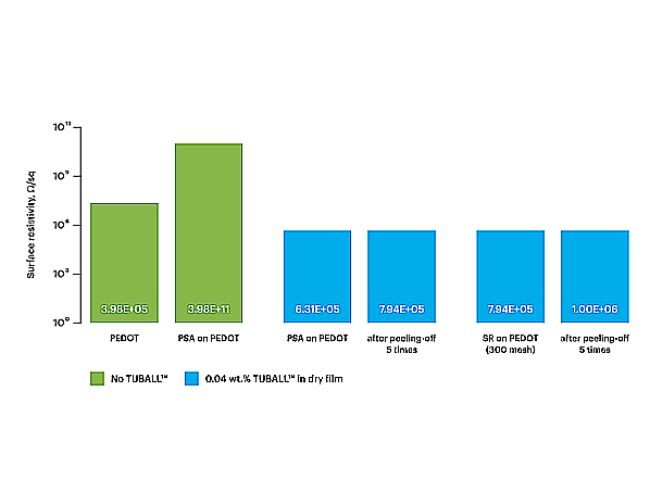
TUBALL™ is OCSiAl’s graphene nanotube technology—an ultra-fine carbon material capable of forming a conductive network in polymers at very low loadings. As a result, TUBALL™ enables adhesive formulations to achieve antistatic/ESD performance while largely maintaining optical clarity, adhesion strength, and good application properties.
In many adhesive systems (especially PSAs), conventional conductive additives typically require high dosages, which can lead to:
- reduced transparency / color shift,
- a significant increase in viscosity,
- negative impact on adhesion or surface appearance.
In contrast, TUBALL™ graphene nanotubes create a continuous conductive pathway at much lower dosages, making the